Kettlebell timer: sets, rests and GS pacing
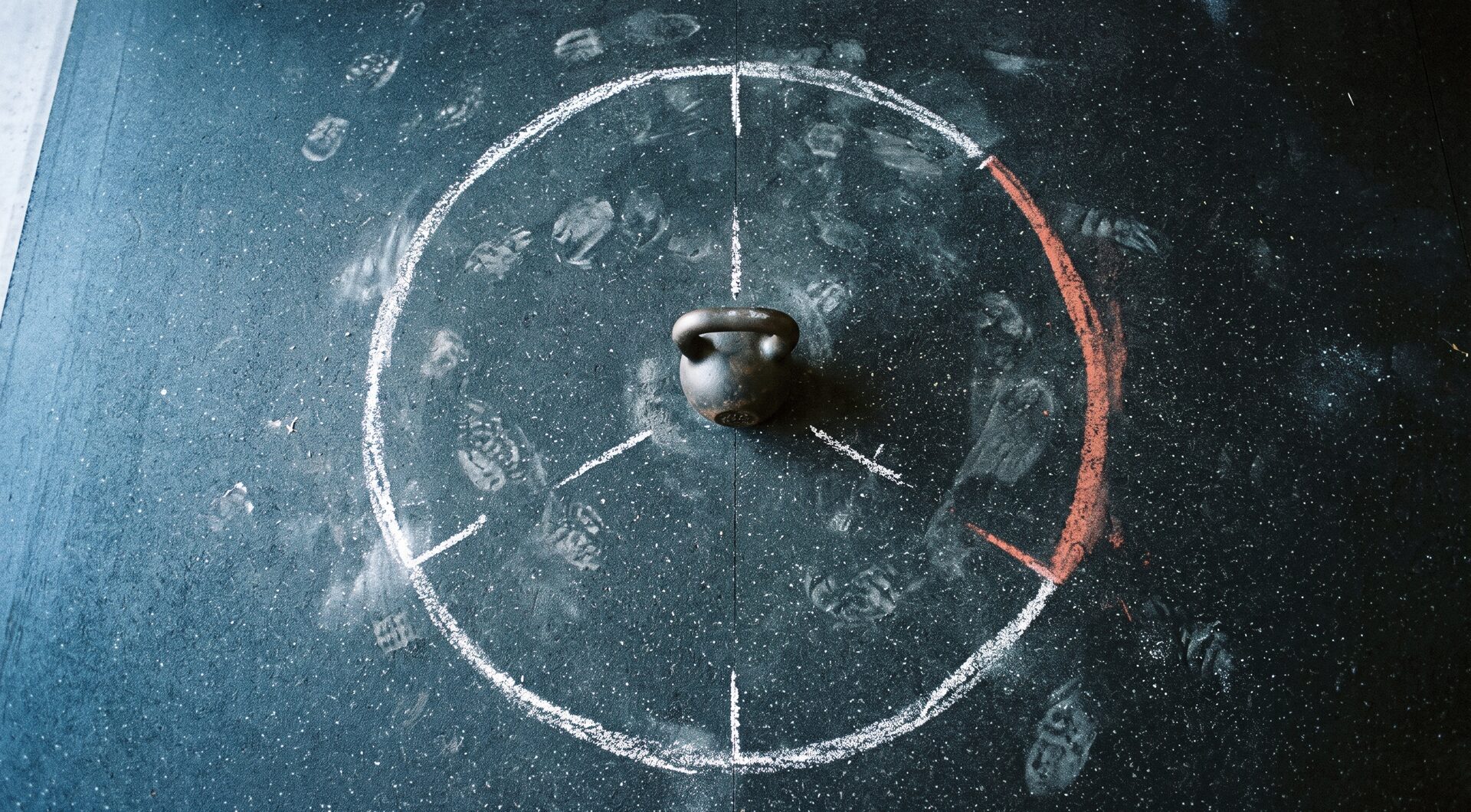
One bell, three clocks. Swings and snatches are ballistic work, timed in seconds. Presses, front squats and rows are grinds, timed in sets and the rests between them. Girevoy sport is timed in whole minutes, paced to the rep. A kettlebell is about the only piece of equipment whose training spans all three regimes at once, which is why the search for a kettlebell timer so often ends in a small disappointment: the timer speaks one clock fluently and mumbles the other two.
The generic picture of a workout timer — eight rounds of something, twenty on, ten off — covers the first clock and calls it a day. The other two get worked around by hand: “I just keep it simple and start a stopwatch. When the minute ticks over, I do the sequence” (r/kettlebell, August 2026) — a lifter pacing minute-long girevoy sets on hardware with no minute calls. A kettlebell session asks for more than a workaround. The same hour can hold a swing block on 30/30, presses resting two minutes between sets, and a closing long cycle set judged by how many honest minutes you can pace. Those are interval structures all three, just with very different numbers in the fields.
Seconds: the ballistic clock
Swings, snatches, and their cousins live short and fast. The templates that carry most swing conditioning are 30/30 on the minute and the denser 40/20, and the swing-intervals guide argues them in full: repeatability is the goal, the rest keeps round nine matched to round one, and the cue that ends a set is bell height, not the clock. None of this asks anything unusual of an interval timer.
One habit travels up from this regime to the other two. Ballistic work punishes touching the phone mid-session — chalk or sweat, either one — so the session gets built once, before the hands are dusty, and then started and left alone.
Sets and rests: the grind clock
A press is not thirty seconds of anything. It is five reps, or three, or a double that takes eight seconds and costs two minutes. The unit on this clock is the set, and what surrounds it is programmed rest: a number chosen for a reason and kept there. The full argument for timed rest between sets runs on barbells, and every word of it transfers: head-counting drops out when you are breathing hard, the wall clock anchors badly, and the phone is the accurate clock that gets used for something else.
On a timer, a grind block becomes a work window plus a rest. What the bell adds is the rack: double bells sit on your chest between reps of a press, and the forearms of a front squat are holding position, not hovering over a screen. Size the window to the real length of the set — forty seconds holds five presses with air to spare — and let the rest carry the prescription; whatever runs the block will be running it from across the room.
Minutes: the GS clock
Girevoy sport, GS, inverts the usual interval bargain. Tabata timing guards against too much rest; GS timing guards against too much enthusiasm: a set that opens at a sprint is a set that ends with the bell on the floor, and putting the bell down ends the set. Training therefore runs on fractional sets of whole minutes — 10 × 1:00/1:00, 5 × 2:00/2:00 — with rest fixed at one to three minutes and identical every round. The GS-sets guide covers the protocols; what belongs here is the pacing.
Pacing means a rep count per minute that the last minute can still pay, and a rep count is checked against the clock’s minute calls, minute one against minute five. The stopwatch lifter from the opening was making that check by glancing, and neither a rack position nor a chalked grip is free to glance.
One session, all three clocks
Where a kettlebell timer earns its keep is the whole evening: swings to open, presses in the middle, a long cycle finisher, each with its own numbers, and no standing around re-entering them with chalk on your hands. The community version is verbatim: “setting up multi-block sessions with different work/rest ratios instead of resetting the timer” (r/kettlebell, March 2026).
That is a solved problem if the timer treats a session as a list of blocks. The swing block keeps its 30/30, the press block its 40-second window and two-minute rest, each with its own times inside one saved program — the same machinery that lets a mixed circuit give every station its own budget, just at the scale of a whole hour. A swing block on the minute is an EMOM wearing chalk; it slots into the list like any other round.
Then the session gets a name. Saved as a named preset, “Tuesday” turns next week into one tap: swings, windows, rests, finisher, the whole hour typed in before the chalk goes on.
What chalk does to the controls
Every demand on this list comes from the same place: your hands are full, dusty, or holding iron.
Cues arrive by voice, over whatever is playing, with the music volume and the cue volume set separately so the minute call rides above the song. The screen, dark, runs the session from a pocket or a bench; if you must look, the round number and the phase read from across the room, because the middle of a squat is not a walking-over-to-check moment. The final bell sounds different from the interval ones, so a finished session announces itself instead of dissolving into one more rest. And all of it — blocks, windows, rests, rounds — survives being carried around a room that contains a swinging weight.
The Tuesday preset, written out
Prep 0:15. Swings, 8 × 0:30/0:30. Transition rest 2:00. Presses, 5 × 0:40/2:00. Long cycle to finish, 2 × 1:00/1:00, the second minute honest. Add it up and the whole evening is 27:35, last rest counted — and the second long-cycle minute, the one where pacing either holds or collapses, is timed by the same bell that counted the swings. One clock after all. It just needed to speak three languages.
FAQ
Do I need a kettlebell-specific timer app?
No, and most of them are general interval timers wearing a kettlebell icon. What the bell actually needs is coverage of three regimes: second-scale intervals for ballistics, a work window plus programmed rest for grinds, and minute-long blocks with voice calls for girevoy pacing. Any timer whose work and rest adjust freely in whole seconds, saves sessions under names, and speaks its cues out loud over your music handles all three.
How do I time kettlebell presses and squats when the set isn't timed?
Give the set a work window sized to how long it really takes, then program the rest you actually want. Five presses with a clean first might need forty seconds; the two minutes after them is the part worth timing. The window starts the rest clock when it closes, so keep it close to the set's true length and resize it between sessions, not during.
How long should rest be between kettlebell sets?
It depends which clock you are on. Inside ballistic intervals the rest is part of the template, thirty seconds in a 30/30. Between grind sets it follows the goal, the same one-to-three-minute range barbell training uses. Between girevoy sets it is fixed, one to three minutes, identical every round, because a drifting rest makes your training log lie. The exact number matters less than its being the number you decided on.
Can one timer run swings, presses and long cycle in the same session?
Yes, and that is the whole point of saving it as one named preset: blocks with different work and rest lengths chained together, run start to finish without stopping to re-enter numbers mid-session. Warmup, ballistics, grinds and a finisher ride in a single program, and next week the same session is one tap away.
Time the rest. Leave the phone alone.
Set the rest between sets once and a voice counts you back in, so you never pick up the phone with your hands full. Screen off, no ads.
Get it onGoogle PlayOn an iPhone? Leave an email and get one message when the iOS app ships.
One email only. Unsubscribe in one click.